Another MVP pivot

Mays Copeland
I wrote earlier about the breakthrough I had when I shifted MVP's architecture to go all-in on a Chrome extension.
Another shift has opened another breakthrough.
The first path: Replacing league pages with MVP versions
I got going on the Chrome extension on March 2, and here was my first idea: MVP would replace each page on your league site with a better version. I would insert an "MVP Mode" button onto each page, and clicking it would toggle the contents of the page into my re-imagined, advanced version of that page.
If you read my false starts post, you'll notice that much of my thinking has been modeled on the ideal fantasy platform. I've studied every platform, taken the best each had to offer, and distilled the pure essence of the perfect fantasy platform.
I thought this would make some stuff easy: If we're already on the roster page, I can peek at the original version of the page to see which slots players were in, or check their IL status. Basically, I could avoid extra fetching because most of the data I needed was already loaded.
I started with Fantrax, obviously, because their F-tier UI is in the most need of improvement. And my idea worked, but it felt really slow. Why? Well, because Fantrax loads tons of bloat on every page, and--even though I was hiding it--I was still letting it load.
So, even though everything was working, I wasn't completely happy with where I was headed.
The team + waiver view
Somewhere here (March 15, to be exact), a vision popped into my head: Wouldn't it be nice to see your team and available players at the same time?
I'm sure everyone has their own daily process for checking their fantasy leagues, but mine is something like this:
- Check standings, and check transactions for newly available players
- Check results from last night
- Set lineups for today
- Add players as injury replacements
The waiver check was inconsistent. I only did it if I was actively looking for a replacement, which meant sometimes missing out on players I didn't realize were available. It also often involved flipping back to my roster page to decide if the add was worth the drop.
So that was my insight: What if MVP could show you the waiver wire next to your roster?
I liked the idea, but it didn't map onto the one-to-one page replacement model I had built so far. Which was kind of okay. As I said, the page replacement idea was feeling a little sluggish. My hesitation was that I would be on my own to collect the data I needed.
The second path: The standalone MVP dashboard
My debate went something like this:
- The page replacement model let me access league data easily, but it was slow and confined me to existing data presentations. And, while the data would be accessible, I'd need to build out a separate converter for each platform to get the data in a consistent format.
- A standalone dashboard would be faster and let me present data however I wanted, but I'd be on my own for fetching the data I needed. However, I could just pick a single source for schedules, injury updates, news, etc. and not have to build an adapter for every site.
Eventually, the second idea won out. I scrapped most of the progress I had made down the first path, and started down the second road.
Here's how it looked after two weeks of part-time building:
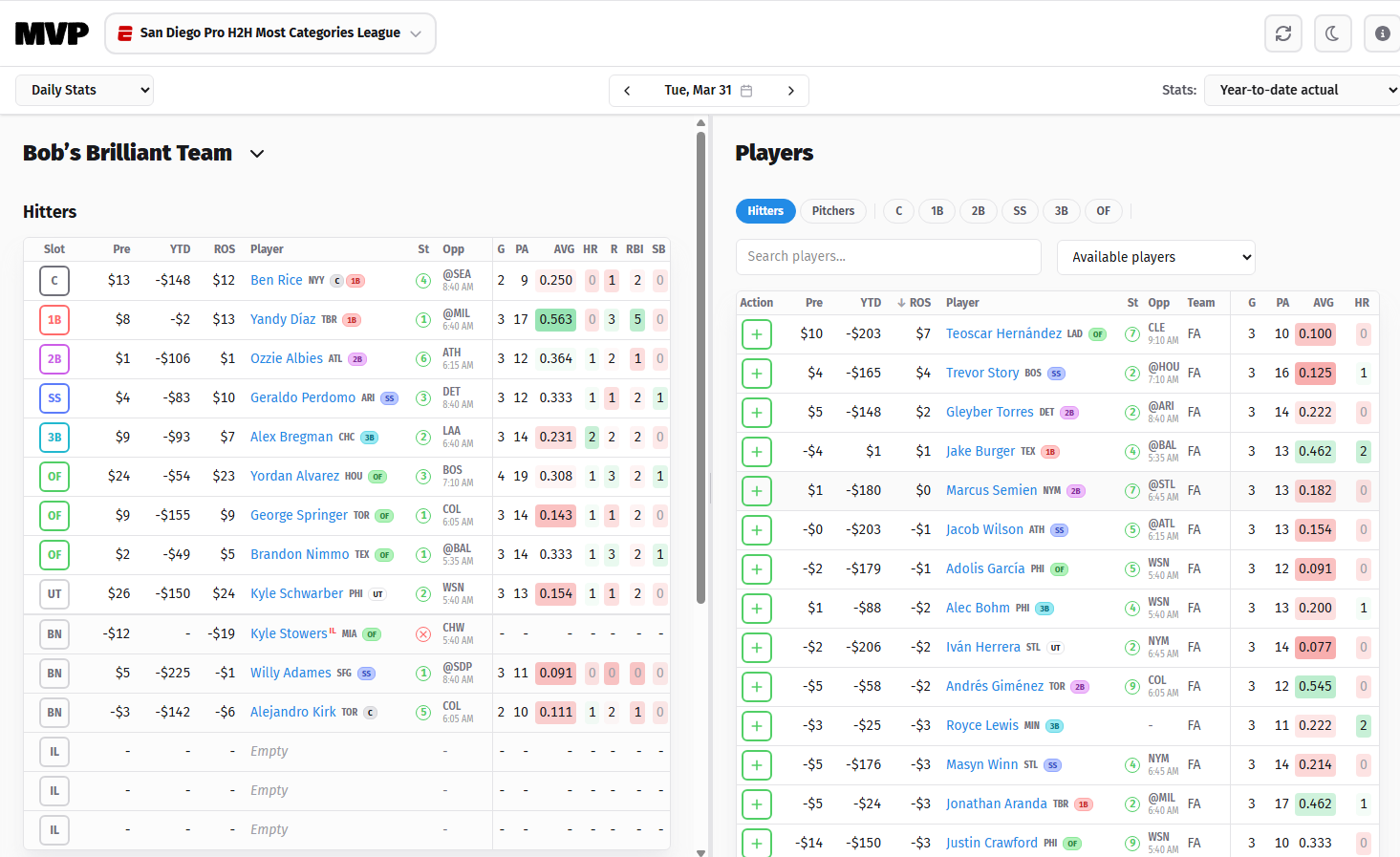
So far, so good. It's now syncing with Yahoo, ESPN, CBS, and Fantrax, and it even lets you set your lineups from all of those sites as well.
Stop guessing. Start winning.
MVP gives you clear, projection-driven answers to your toughest in-season fantasy decisions.
Get MVP